Understanding family dynamics from the inside is rarely straightforward. For one young man, real clarity came only much later—after something seemingly trivial began to carry unexpected weight.
I couldn’t stand my uncle growing up.
That’s the truth—no sugarcoating it.
He was the kind of man who could turn any moment into a lecture. If I got a B, he’d ask why it wasn’t an A. If I laughed too loud, he’d tell me I sounded foolish. Every holiday, every family gathering—he always had something to criticize. I learned early how to deal with him: short answers, polite smiles, then disappear.
So when he got cancer, I wasn’t exactly heartbroken.
And, from the looks of it, neither was anyone else.
Weeks passed, and my mom kept saying, “You should visit him.” I always had an excuse. School. Work. I’m busy. I’ll go next week.
Then one day, she said quietly, “He keeps asking if you’ll come.”
That… stayed with me.
Not because I believed he loved me. But because something about it made me feel like I owed him something. Or maybe I just didn’t want to feel like a bad person.
So I went.
The hospital room smelled sterile, heavy with that uncomfortable silence. He looked smaller than I remembered. Weaker. His sharp voice was gone.
He didn’t criticize me.
He barely spoke at all.
We sat there—exchanging a few awkward sentences, letting long pauses fill the space between us. I remember thinking, This is pointless.
As I got up to leave, I noticed something in his hand: an old, worn photograph. Two kids stood beside him, all smiling—his children.
I didn’t ask about it.
I just said goodbye and walked out, already reassuring myself: Okay, I did my part.
A few weeks later, he passed away.
The funeral was small. Quiet. Not many tears.
Then came the will reading.
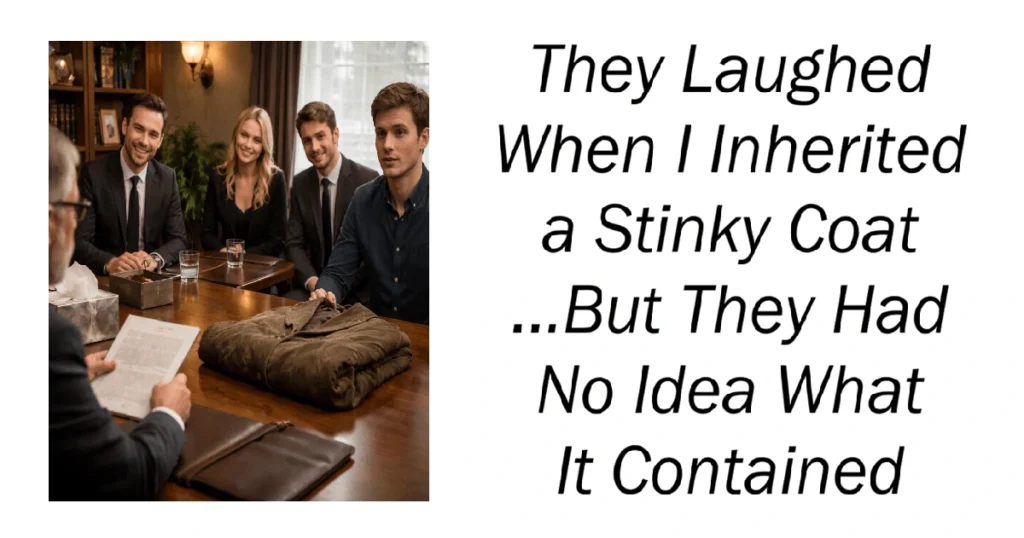
His children sat across from me—well-dressed, composed. You could almost see the calculations happening behind their eyes.
The lawyer cleared his throat.
Forty thousand dollars, split evenly among his children.
They nodded. Expected. Uneventful.
Then the lawyer paused and looked at me.
“And to his nephew…”
I straightened slightly.
“…he leaves his coat.”
Silence.
Then his son laughed—a real, open laugh.
“Classic Dad,” he said, shaking his head. “Final prank. Enjoy the stinky coat.”
A couple of them smirked. One didn’t even try to hide it.
I forced a smile, my face burning. “Cool. Thanks.”
Honestly, I felt stupid for even being there.
A coat? That’s what I got?
I took it home, tossed it over a chair, and ignored it for two days.
I almost threw it away.
But something stopped me.
Maybe curiosity. Maybe stubbornness.
Eventually, I picked it up and slipped my hands into the pockets.
That’s when I felt it.
Paper.
I frowned and pulled out a sealed envelope—my name written across the front in his handwriting.
My chest tightened.
I don’t know why my hands started shaking, but they did.
Inside was a letter.
And a small key.
I sat down before I began to read.
His words were… different. Not sharp. Not critical. Just clear.
He wrote that his children would fight over the money—that they always did.
“Let them,” he said.
Then he explained the key.
It opened a safety deposit box.
Everything inside it… was mine.
For a moment, I couldn’t breathe.
Then I read the line that hit hardest:
“Because you came to see me when you thought I had nothing left to give.”
It was true.
I hadn’t gone out of love. Not really. But I had gone—when no one else did.
I kept reading, my vision beginning to blur. He told me where the bank was, which box, what I’d need.
And then, at the end—
“The coat was the only thing they wouldn’t fight you for.”
I laughed.
A broken, unsteady laugh that turned into something else entirely.
Because suddenly, everything about him made sense. The harshness. The distance. The way he never showed anything soft.
And yet… this.
The next day, I went to the bank.
The process was a blur—forms, identification, waiting.
Then they brought out the box.
Small. Unremarkable.
My hands were still shaking as I unlocked it.
Inside was a stack of documents.
At the top—a deed.
Property.
Value: $600,000.
I stared at it, certain there had to be a mistake.
But there wasn’t.
It was all there. Signed. Official.
Mine.
I sat there for a long time, just processing.
And then, for the first time in my life, I cried because of him.
Not because he died.
But because I finally understood him—too late.
He wasn’t the man I thought he was.
Or maybe he was.
Just not only that.
The coat still hangs in my closet.
I’ve never washed it.
I never will.
Because every time I see it, I remember the lesson he left me with:
Sometimes, the things people don’t fight over… are the ones that matter most.